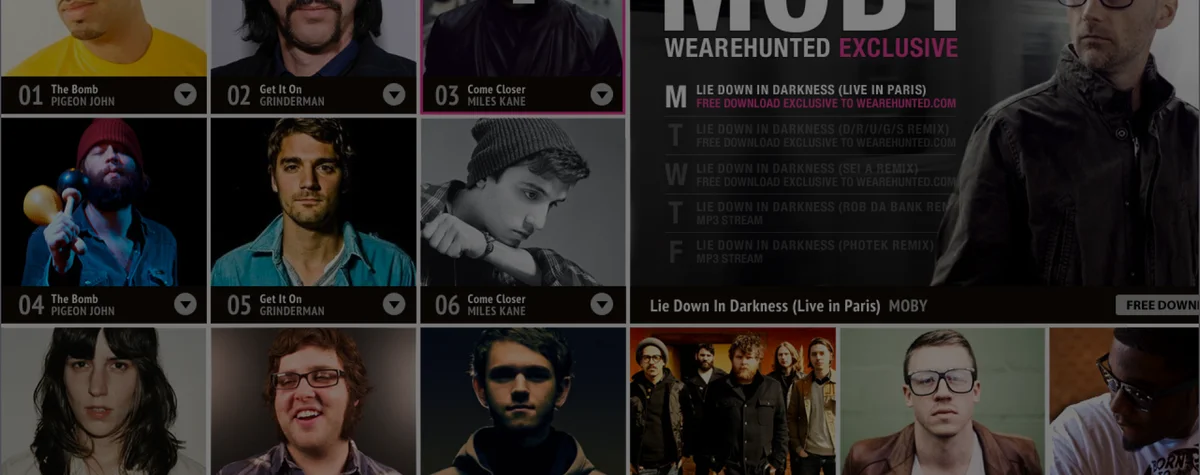

Building a music discovery app inside Spotify for one of Australia's most innovative music startups.
Spotify's App Experiment
Between 2010 and 2012, Spotify ran an experiment inside their desktop application. Brands and developers could build apps that lived inside the Spotify client itself. Not web apps that opened in a browser. Actual applications embedded in the player, running alongside the music. It was an ambitious idea that only lasted a couple of years before Spotify deprecated the feature entirely.
During that short window, I became one of the go-to developers for these applications. Working at We Are Hunted in Melbourne, I built Spotify apps for multiple brands including eMusic, Reebok, Ticketmaster, and Sony's Legacy Recordings. But the We Are Hunted app was the one closest to home.
The Brief
We Are Hunted was a music startup that tracked what was trending across the internet. The team had built algorithms that crawled music blogs, social media, and download charts to surface songs that were gaining momentum before they hit mainstream. Think of it as an early version of what Spotify's own Discover Weekly would later become.
The Spotify app brought that trending data directly into the player. Users could browse We Are Hunted's charts, discover emerging artists, and play everything without leaving Spotify. It was the company's flagship product inside the platform, and as lead developer, I owned the entire front-end build.
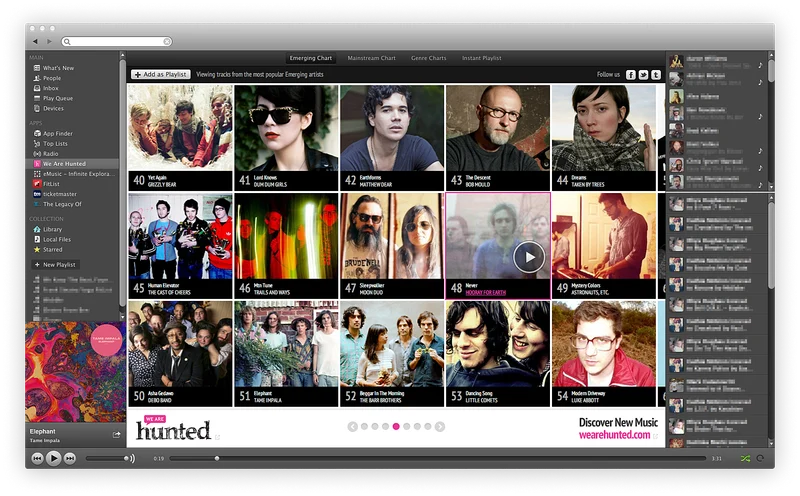
Building Without Documentation
The Spotify Apps API was barely documented. There were a handful of community examples and some sparse official guides, but large chunks of the API were essentially undocumented. You'd find yourself reading source code, experimenting with endpoints, and comparing notes with the small community of developers building on the platform.
These were single-page applications built years before React, Angular, or any of the modern frameworks existed. The stack was HTML, CSS, jQuery, and a state management system I built myself using a combination of jQuery patterns and vanilla JavaScript. Every app I shipped on this platform used the same architectural approach: namespaced modules, manual memory management, jQuery UI for interactions, and templating for dynamic views.
After building several apps this way, I decided to write the documentation that didn't exist. I created Foundation, an open-source demo application and reference guide that walked developers through the Spotify Apps API with real examples. It covered everything from basic API usage to advanced patterns like plugin integration and app organisation. It's still on my GitHub today.
The Role
I sat between two teams: Spotify's developer relations group in Stockholm and the We Are Hunted product team in Melbourne. When something didn't work as expected, I'd debug it against undocumented behaviour, file issues with Spotify's team, and find workarounds to keep shipping. The collaboration was close. Spotify were genuinely interested in what developers were building, and they'd sometimes adjust the platform based on feedback from the apps we were building.
What Happened Next
Spotify shut down the apps platform in 2014. We Are Hunted was acquired by Twitter in 2013, where the team's music discovery technology was folded into Twitter's own music efforts. The Spotify app, like all apps on the platform, stopped working when the feature was removed.
Looking back, these apps were genuinely ahead of their time. We were building rich single-page applications inside a desktop client, with live data feeds and music playback integration, years before that kind of embedded app experience became common. The patterns I developed for state management and modular architecture in these apps directly informed how I thought about front-end architecture for years afterwards.