
A concert discovery and ticketing app for Ticketmaster, built inside Spotify's desktop platform.
Spotify's App Experiment
Between 2010 and 2012, Spotify's desktop application included an experimental feature: brands could build apps that ran inside the player itself. These were embedded applications, not web links. Users could interact with them without leaving Spotify. The experiment attracted a range of brands and music services before being deprecated.
I was the lead developer on several of these apps while at We Are Hunted, a music startup in Melbourne. We worked with brands who wanted to build on the Spotify platform, and Ticketmaster was one of the bigger names.
The Brief
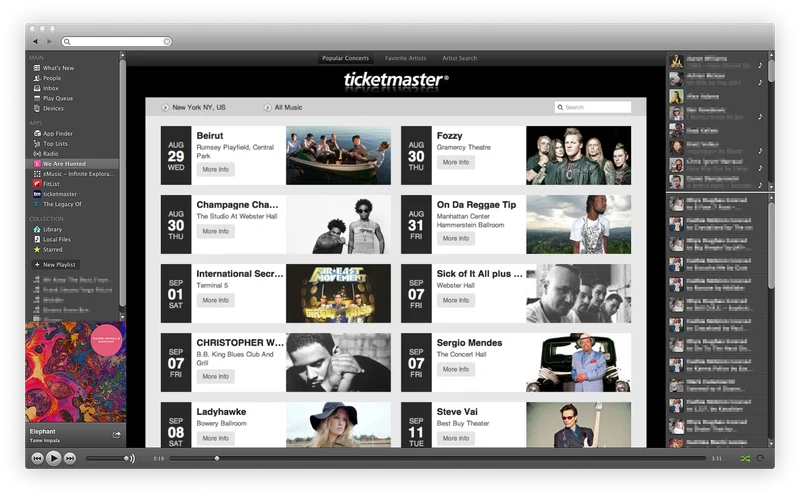
The idea was simple and compelling: connect the music someone was already listening to with live shows they could attend. The Ticketmaster app surfaced upcoming concerts and events based on the artists in your Spotify library. You're listening to a band, and right there inside the player, you could see if they were playing near you and buy tickets.
This was years before Spotify built their own concerts feature. At the time, there was no native way to discover live events inside the app. Ticketmaster saw the opportunity to be that bridge between streaming and live music.
Building on an Undocumented Platform
The Spotify Apps API was famously underdocumented. Official guides covered the basics, but anything beyond a simple app meant exploring undocumented behaviour, debugging blind, and working around limitations nobody had written about. I spent a lot of time in direct communication with Spotify's developer relations team in Stockholm, reporting issues and requesting features.
The tech stack was HTML, CSS, jQuery, and a custom SPA framework I'd built for the platform. No React, no Angular, no build tools as we know them today. These were hand-rolled single-page applications with manual state management, module namespacing, and careful memory handling. After building multiple apps on the platform, I created Foundation, an open-source reference application that documented the API properly. It included real-world examples and patterns from the apps I'd shipped.
The Integration Challenge
The Ticketmaster app had an additional layer of complexity compared to the other Spotify apps I built. It needed to pull data from Ticketmaster's event API, match it against Spotify's artist metadata, and present results that felt relevant rather than noisy. A mismatch between Ticketmaster's artist naming and Spotify's catalog could surface the wrong shows or miss them entirely. Getting that matching logic right, within the constraints of a client-side app running inside someone else's platform, took more iteration than I'd expected.
What I Took From It
Spotify deprecated the apps platform in 2014. Years later, they built their own native concert discovery feature that did essentially what the Ticketmaster app had done. The idea of connecting streaming data to live events was clearly right. The timing and platform were just early.
The Ticketmaster project was a good lesson in building integrations between two large systems where neither side fully controls the data. Artist matching between different platforms is a problem that still shows up everywhere in music tech. Working through it in 2012 with limited tools and no documentation was formative.