

A fitness-meets-music app for Reebok, built inside Spotify's desktop platform.
Spotify's App Experiment
Between 2010 and 2012, Spotify ran an experiment inside their desktop application. Brands could build apps that lived directly inside the Spotify client. Not links to external websites. Actual embedded applications running alongside the music player. It was a bold idea that attracted brands looking for new ways to connect with music listeners.
I was the lead developer on several of these apps while working at We Are Hunted, a music startup in Melbourne. We consulted to brands who wanted to build on the Spotify platform. Reebok was one of those brands.
The Brief
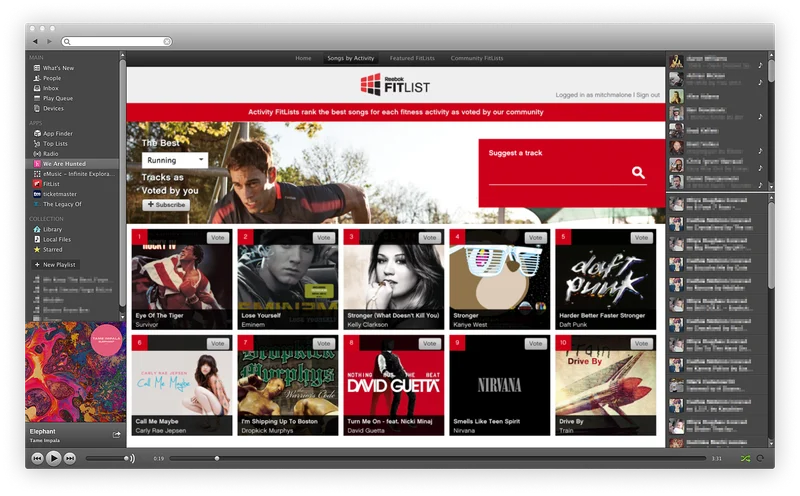
Reebok wanted a workout music experience inside Spotify. The idea was straightforward: curated playlists designed for different types of exercise, accessible without leaving the player. Users could browse by activity type, find music matched to their workout intensity, and play it all directly within Spotify.
FitList was a crossover between fitness branding and music curation. Reebok provided the workout categorisation and brand direction. We Are Hunted brought the music data and I handled the technical build. The challenge was making a branded experience that felt native to Spotify rather than like an advertisement sitting inside someone's music player.
Building on an Undocumented Platform
The Spotify Apps API was notoriously undocumented. There were some community examples and sparse official guides, but much of the platform's behaviour had to be discovered through experimentation. I spent a lot of time reading source code, testing edge cases, and comparing notes with the handful of other developers working on Spotify apps globally.
These were single-page applications built years before React or any modern front-end framework existed. The stack was HTML, CSS, jQuery, and a custom state management system I'd developed specifically for the Spotify platform. After building multiple apps this way, I wrote Foundation, an open-source reference application and documentation project that gave other developers a proper starting point. It's still on my GitHub.
The Role
I sat between three teams on this project: Spotify's developer relations in Stockholm, the Reebok brand team, and We Are Hunted's product group in Melbourne. Each had different priorities. Spotify cared about platform consistency. Reebok wanted brand presence. We Are Hunted needed to deliver a polished product on deadline. My job was to make all three happy while working around the platform's quirks.
What I Took From It
Spotify deprecated the apps platform in 2014, and FitList went with it. But the project taught me something useful about building branded experiences inside someone else's product. The constraint of working within Spotify's UI meant every design decision had to balance brand identity against platform conventions. Too branded and it felt like an ad. Too native and the brand disappeared. That tension shows up in a lot of product work, and learning to navigate it early was valuable.