
A catalog discovery app for Sony's Legacy Recordings label, built inside Spotify's desktop platform.
Spotify's App Experiment
Between 2010 and 2012, Spotify had an experimental feature in their desktop app that let brands build applications embedded directly inside the player. These weren't web links or external redirects. They were full interactive experiences running inside Spotify's client. The experiment lasted a couple of years before the platform was deprecated.
I was the lead developer on multiple Spotify apps while working at We Are Hunted, a music startup in Melbourne that consulted to brands wanting to build on the platform. Legacy Recordings, Sony Music's catalog division, was one of those brands.
The Brief
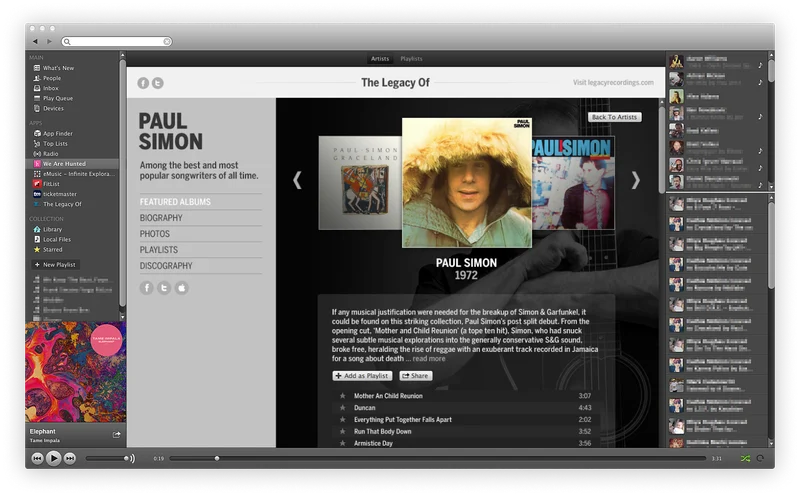
Legacy Recordings is the catalog arm of Sony Music. They manage the back catalogs of artists like Miles Davis, Johnny Cash, Bob Dylan, and hundreds of other legendary musicians. The brief was to build an app that helped listeners explore this deep catalog within Spotify. Not just a list of albums, but a browsing experience that gave context to the music and made it easy to discover artists you might not have searched for on your own.
The app was called "The Legacy of" and it surfaced curated collections and artist stories from the Legacy Recordings catalog. Working with a label that represented decades of recorded music history made the content side of this project richer than most.
Building on an Undocumented Platform
The Spotify Apps API was barely documented. Official guides existed but were sparse, and a lot of the platform's behaviour had to be figured out through trial and error. I spent significant time debugging undocumented edge cases, testing API endpoints, and finding workarounds for limitations that weren't mentioned anywhere.
These were single-page applications built before React, Vue, or any modern front-end framework. The tech stack was HTML, CSS, jQuery, and a custom state management system I'd built specifically for Spotify's platform. It included namespaced modules, manual memory management, and a templating layer for dynamic views. After building several apps this way, I created Foundation, an open-source reference application that documented the API properly for other developers.
The Role
I worked between Spotify's developer relations team, the Legacy Recordings group at Sony, and the We Are Hunted team in Melbourne. Sony brought the content and brand requirements. Spotify provided the platform and occasional technical support. I built the app and handled the back-and-forth when things didn't work as expected, which was often enough that having a direct line to Spotify's team in Stockholm was essential.
What I Took From It
Spotify deprecated the apps platform in 2014, and The Legacy of went offline with everything else on the platform. But working with Legacy Recordings taught me something about building for content-rich domains. When you're surfacing decades of music history, the technical build is only part of the problem. The harder part is making navigation feel intuitive when the catalog is enormous and the relationships between artists, eras, and genres are complex. That's a design challenge I've encountered repeatedly since, in different contexts.